

On becoming a catechist
Or rather, five things I’m learning in the atrium
Dear friends,
Somehow, by God’s clever grace, I continually find myself in humbling, formative spaces of deep listening. I’ve received the gift of my husband, a chaplain and priest, the gifts of my children, the gift of becoming a spiritual director, and now most recently, the ability to participate in Catechesis of the Good Shepherd (CGS) as a catechist. Each role is distinct, of course. And yet, there are similar threads of patience, surrender, discipline, and charity woven between them.
If you’re unfamiliar, Catechesis of the Good Shepherd was developed by two Catholic laywomen in Rome, Sofia Cavalletti and Gianna Gobbi, who studied and worked directly with Maria Montessori’s educational philosophy in the 1940s and 50s. Their work flourished into a robust Christian formation program — extending into Catholic, Protestant, and Orthodox churches — for children up to twelve years old. This approach affirms a young child’s existing relationship with God and seeks to develop this divine conversation, while also fostering deeper engagement with the sacramental life of the church. Children are welcomed into a contemplative environment (the atrium) with materials related to practical life, the liturgical year, the life of Jesus and the parables he shared, as well as relevant geography. Arguably the most significant materials include a model altar, baptismal font, and prayer table.
The atrium is a place of prayer; the catechist is simply a guide. And while that might sound odd for children as small as three, the prepared environment really does draw out beautiful, celebratory responses while they work with simple, handmade materials.
“The atrium is not a place of religious instruction, but of religious life. It resembles a classroom in that it is a place of work and study; in the atrium, however, work and study become colloquy with God, and therefore it is already a place of worship in some sense.”
Sofia Cavalletti, The Way of Holy Joy, p. 41
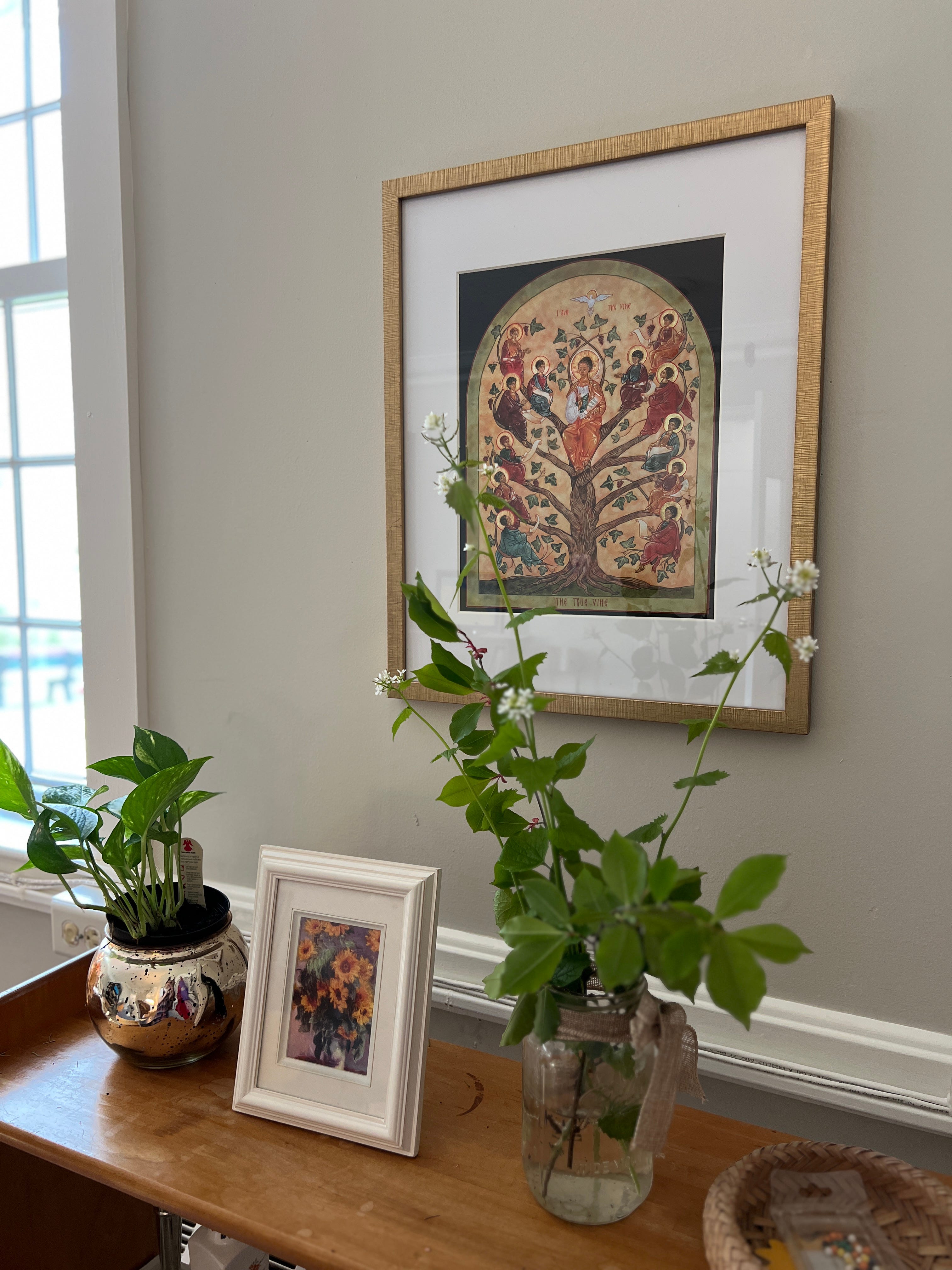
What is most essential?
As I started having children, I could easily name what I didn’t want in their spiritual formation. It took longer to catch a vision for what it could be. I prayed they would experience joy, reverence, and wonder in their prayer lives without indoctrination or fear. Within their baptisms they were marked as Christ’s own forever, and I hoped that would not be questioned. I wanted the Gospel to touch their hearts. I wanted each of their senses to pick up on the story of God within the liturgy.
CGS answered those prayers with a question: What is the most essential?
Oddly enough, this very question prompted my initial introduction to liturgical worship and ushered me into the Anglican Communion almost a decade ago. Returning to this question — especially as a parent — offered a helpful framework for our family. What was the most important message we wanted to share with our children? And what felt secondary?
Cavelletti describes the process of researching and curating materials to offer the children. She paid close attention to their responses. When presentations were received with “naturalness, depth, and joy,” the children were truly being nourished.
“Thus our work consisted in stripping away many secondary elements we were giving to the children (to which the children remained indifferent and the materials languished on the shelves), to concentrate on the essential, that “essential” Franz Marc spoke of this way: “The spiritual life is to distinguish the essential from what is not… ”
Sofia Cavalletti, Way of Holy Joy, p. 47
The essential messages of the Christian faith enliven the child’s heart. For early childhood, enjoying God (and recognizing how much God enjoys us) is the main focus. This echos an observation of Montessori’s, that joy was intricately related to attention and growth. Cavalletti goes on to explain what this joyful response looks like:
“There is a different sort of happiness we witness when the child draws close to God, and we call it by a different name: joy. It is manifested in a particular peacefulness and contentment in the child.”
Sofia Cavalletti, The Religious Potential of the Child, p.13
This foundation, alongside the proclamation of Christ as the Good Shepherd and the emphasis on the sacraments put CGS as the top choice for our family, and ultimately our parish. As time went on, I watched my oldest child experience that sense of contentment while arranging flowers for the prayer table or in noticing the liturgical colors. My youngest child, who by proximity spends more time in the atrium than most her age, will begin singing as she carefully sets out the chalice and paten on the model altar.
“The child goes to God in joy and recognizes God in joy.”
Sofia Cavalletti, The Religious Potential of the Child, p. 25
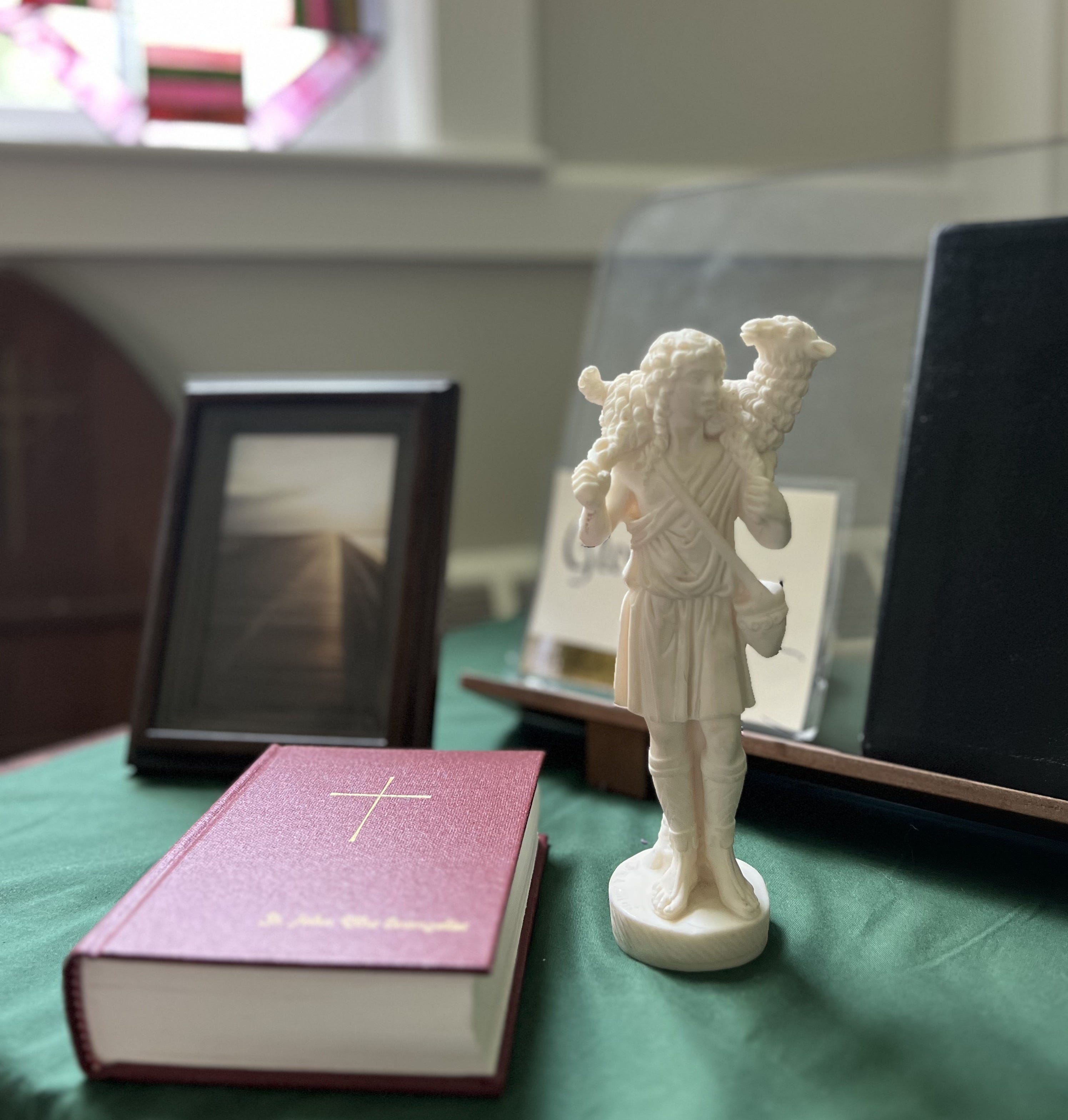
Five things I’m learning in the atrium
I came to CGS with a background in theology and spiritual direction, but I hadn’t spent much time with children’s spirituality. Over the course of 100+ hours in training for Level 1 (3-6 year olds), I’ve reached just the tip of the iceberg.
Children have an innate hunger for spiritual food.
I was surprised to discover it wasn’t too difficult to pull from my knowledge of both Charlotte Mason’s and Maria Montessori’s educational philosophies while working in the atrium. They certainly came to different conclusions in many ways, but as a devoted Anglican and Catholic respectively their work appears to overlap when it comes to religious education. Mason’s first educational principle declared children as born persons; Montessori believed strongly in the God-given dignity of the child.
Because of this, both believed the child to have an innate spiritual needs. They are not empty vessels waiting to be filled with information or didactic facts, rather their hearts are open to God, waiting to experience more of God’s love.
“The child’s need to be loved depends not so much on a lack that requires filling, but on a richness that seeks something that corresponds to it.”
Sofia Cavalletti, The Religious Potential of the Child, p. 16
This hunger is to be met with God’s word, directly from the Bible in developmentally appropriate portions. Children are to be fed according to their “vital need” and given a diet of the “greatest realities” which “aid in continuing the child’s meditation [usually on a presentation on a scripture passage or aspect of the liturgy].”1 The materials provided to even the youngest children — scripture booklets, prayer cards, liturgies — are taken directly from scriptural or liturgical sources. They readily receive these texts, whether read aloud or to themselves. Their observations and questions are (usually) astute.
God is a gift and we are invited into a relationship of joy.
The content in Level 1 is centered on the parable of the Good Shepherd, which informs the children’s understanding of the Eucharist and Paschal Mystery. The emphasis in these early years lies not on Christ’s sacrifice for humankind, but the reality of God offering Godself as the most precious gift to us. You might notice these are two sides of the same coin, but the theology of gift draws the child’s attention back towards God’s desire for a joyful relationship with them.
“Everything is gift in the history of salvation worked by God, through Christ and in Christ.”
Sofia Cavalletti, The Religious Potential of the Child, p. 56
A joyful relationship, or the gift of a covenant between God and God’s people, opens the door for celebration. This divine invitation is marked by rituals of initiation and celebration. This frames how the children learn of the mass, including liturgical gestures and prayers, which in turn deepens their engagement with the liturgy and offers language for their own conversation with God.
A child’s sacramental life is a mystery to be cherished.
Who can adequately explain what happens during the Eucharist? Or inside a child’s heart in prayer? Perspectives and theologies abound, and yet there will always be a bit of mystery. So, while I can’t fully explain the intricacies of atonement theories or real presence to my preschooler, I can put them in contact with the mystery itself.
Early on, the child is told the altar they see in the atrium is a model. It is not a real altar, like the one in the sanctuary. Each time the child arranges the fine linen and the candles or practices the epiclesis or pours water into the model font, they are “trying on” this great mystery. Each point of contact offers another opportunity to listen for the voice of the Good Shepherd.
“There does not exist a Bible that we read and the Liturgy that we live; there is a Bible we live with the whole of our life and especially so in the Liturgy. The former without the latter is deprived of its most intense moment of life; the latter without the former would be based on a void. The Bible finds its fullness in the listening of the community lives in justice and builds itself in the Eucharistic celebration. Therefore, the child who comes to know the Good Shepherd should be initiated into the greatest action in which we meet Him: the Mass… The Mass is the place and time in which we encounter our Good Shepherd in a most particular way; He calls his sheep to come around His altar to feed them with Himself in a special way.”
Sofia Cavalletti, The Religious Potential of the Child, p. 79-80, emphasis added
There was one Sunday I took my littles to visit one of our favorite parishes in Beacon Hill. My eldest was four. Just before she kneeled at the altar to receive the bread and wine, she stopped and looked up. I noticed the look on her face softened as she took in her surroundings. She was concentrating; she was pleased. In Cavalletti’s words, she was experiencing the “serene enjoyment of God”.2 I wish I had more words for that moment, but it was one that perhaps only a mother might notice. I’m so glad I did.
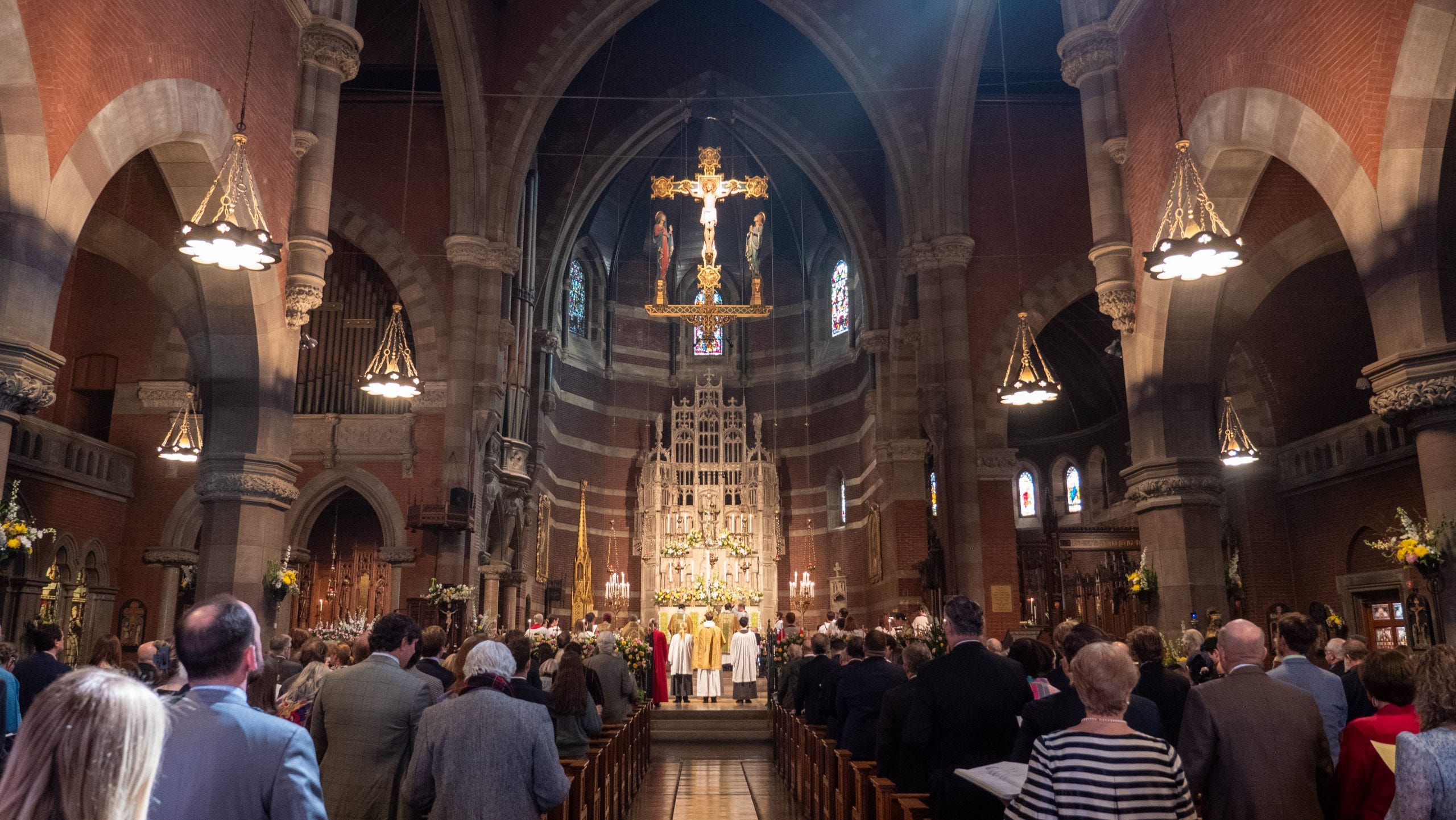
The atrium offers a shared experience for both children and adults.
I need the atrium as much as the children do. The environment, though sized for a child, is capable of holding my wonder and my wordless questions. It blankets me in quiet. There I can sit, unhurried, with the essentials.
“The catechist lives with the child a shared religious experience according to the teaching of the Gospel: "Except you become as little children, you cannot enter the kingdom of God" (Matthew 18:3).”
Point #1, Characteristics of The Catechesis of the Good Shepherd: The 32 Points of Reflection
There’s an assumption that children’s Sunday school programming is a one way street: adults instruct, children receive. CGS believes differently. Both the child and the adult (the catechist, parent, or fellow congregant) can be deeply formed together because the true Teacher is at work through the reading of scripture and the materials included in the atrium. My background as a spiritual director and my own experience in CGS formation allowed me to accept early on. But not everyone does. I wrestle with this, knowing the feast they leave behind.
Adults often have difficulty embracing the essentials of the Christian message. We distract easily. Cavalletti explains, “For the adult the immediate reality at times acts as a screen to the transcendent reality that seems to be so apparent to the child.”3 I found many are hesitant, or even actively resistant, to enter the atrium with childlike trust. This makes me sad, but I understand in part. The logistics of bottom lines and sustainability can get in the way. CGS costs significant time and money, especially on the front end. It’s not an open-and-go curriculum and it doesn’t offer black and white answers. But for those who find a way past all this, they find a deep, deep well of living water.
Children’s spiritual formation is for everyone.
One of our formation leaders reminded us of our baptismal vows in the Book of Common Prayer. When a candidate is baptized, the priest asks the congregation: “Will you who witness these vows do all in your power to support these persons in their life in Christ?”
The congregation responds, “We will!”
The whole congregation bears witness and accepts responsibility. Not just the mothers. Not just the married folks. Not just the priests or deacons. All people have a part to play in supporting a candidate’s life with Christ. For anyone, but most certainly a child, this includes spiritual formation/Sunday school/Christian education.
Cavalletti knew the work of CGS was not exclusive to the four walls of an atrium or the presence of a catechist. A child’s lived experience in their community mattered greatly.
“The initiation of a child into Christian life is not a work that can be fulfilled by the catechist alone, nor by the parents alone. It is the whole Christian community that proclaims Christ, and the child must enter into contact with the entire Christian community. The catechist’s work — valuable as it is — must be sustained and confirmed by a community that lives what the catechist proclaims.”
Sofia Cavalletti, The Religious Potential of the Child, p. 40
This is both a comfort and a challenge to the church at large. Christian communities are, no doubt, human and tangled, but if CGS has impressed anything on me, God can use the smallest seed for his great, heavenly purposes.
Bless you for reading this far. There’s more to say, but I’ll tuck it away for another time. Do you have experience with CGS? Curious about where to start? I’d love to hear about it.
Happy summer!
Elizabeth
Related Resources:
Sacred Spirals is updated and ready for 2026-2027! Find it here.
You might like this older post on spiritual hospitality, In Practice: Placemaking at Home and at Church, or this one on Christian community, An Address on God’s Holy Hill
The Library has been updated with a few new additions for paid subscribers!
Thanks for reading! If you enjoy my work here on Substack, press the little heart at the bottom of the post or share this email with a friend. Those small nudges let me know the topic is meaningful to you and help other folks find my work.
The Way of Holy Joy by Sofia Cavalletti, p. 42
The Religious Potential of the Child by Sofia Cavalletti, p. 56
The Religious Potential of the Child by Sofia Cavalletti, p. 19
What a gift! I've been trying to determine if now is the right time to send our lovely 3yo to CGS - I recall my own catechism as a very quiet, serious affair, and that definitely wouldn't be a good fit for our gal. But CGS sounds like the perfect framework. Thank you for the lovely deep dive! Bon weekend
It’s a delight to read about your experience with CGS! In my own parish I have served in a simplified version of the atrium over the years and being “blanketed in quiet” is such an apt description for that serious and delightful space. And I’m always interested in the parallels and discord between Cavalletti and Mason philosophies—I wish more Charlotte Mason families knew about the good work of this kind or spiritual formation.